Heritage Winter Wheats
and 'new landraces'*
The Heritage Grain Conservancy is a farmer-owned, farm-run cooperative to collect, conserve and restore delicious world heritage grains on the verge of extinction. Our varieties are available in small amounts to multiply and restore. The seeds are offered to you with hope that you will become a new biodiversity center in your own community. We are here to support this in all ways since we have many more rare landrace that are not listed. Like Gandhi's Salt Walk, if small-scale farmers and gardeners work together to restore biodiversity, we can create a viable alternative to the global grain corporate monolith.
Grow a diversity of world landrace wheats. Conduct research with a Noah's Ark of Biodiversity.
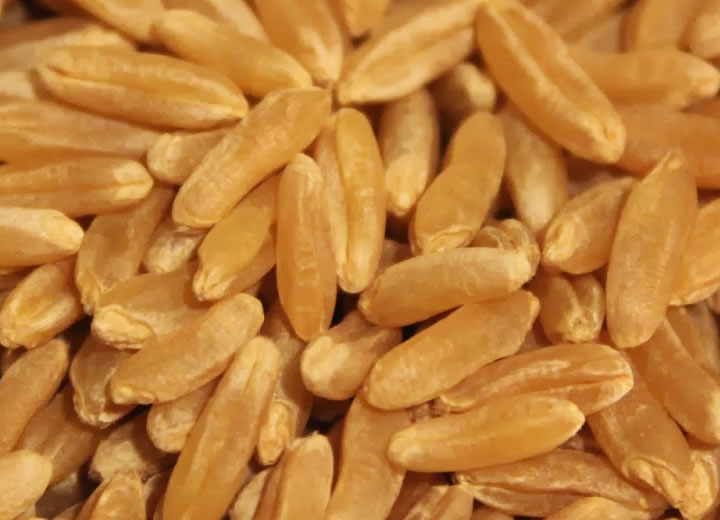
Climate-Resilient Black Winter Emmer
Delicious Black Winter Emmer thrives in drought and rain, is savored in soups, for a hearty breakfast cereal. High in nutrition, one cup- 24 grams of protein. Recipes |
Banatka Vavilov reported: 'Banatka is reknowned for excellent baking quality and wide adaptability'
![]() * Rogosa cross of Banatka x Bankuti 1 oz |
Rouge de Bordeaux beloved by French artisan bakers, rich flavor
1 oz
|
Bezbanatskaja high yield, delicious landrace
for hearty peasant breads 1 oz
|
Caucasus Mountains with French Landrace
Traditional farmers grow mixtures. This allows nature and farmers to co-evolve a locally-adapted landrace. Current research confirms that wheat mixtures tend to yield higher and have richer, complex flavor. Plant each seed 12" apart in deep-dug well-fertilized soil. Plant a low-growing clover or spread mulch between wheats to suppress spring weeds. Heritage wheats are at least twice as tall with a larger root system than modern wheats. Save the seeds from the robust plants that best thrive in your unique soil and micro-climate. Plant a resilient wheat polyculture that can better adapt to your unique fields and local weather. Exchange seed with your neighbors to build a community wheat supply.
'Looking at the field of ripening grain, Vavilov realized it was not a uniform wheat cultivar, but a panoply of intermixed strains of grain that formed a resilient polyculture. It was necessary to collect hundreds of seedheads for a representative sample of the vast biodiversity in a single field...The traditional farmers' methods of crop selection enhance landrace wheats' biodiversity; Their criteria of complex traits include: flavor, texture, health, maturation and more.' Where Our Food Comes From. Gary Nabhan p. 139
Elite landrace winter wheat mixture of: French Canaan Rouge and Ancient Ukrainian Poltavka


Poltavka was collected in 1915 at the site of ruins of an ancient cereal goddess temple in Poltavka.
Canaan Rouge* is a exquisite 'new landrace' selected/crossed by Eli Rogosa in Canaan, Maine. This is a mixture of our two most delicious landraces.
Pleases specify if you only want only one variety or both: Poltavka or *Canaan Rouge
Hourani Biblical Wheat The ancient wheat variety discovered in the Masada Fortress by Yigal Yadin, translator of the Dead Sea Scroll, stored 2,000 years ago by King Herod. This is the wheat eaten by ancient Israel. but today is almost extinct. Collected by Nikolai Vavilov in 1926. and by Eli Rogosa in 2008, Wadi Fukin
Hourani - ancient biblical wheat eaten 2000 years ago in Jerusalem Available on special request.
|
Emmer Flour
Ancient Grain Posters
|
|
|